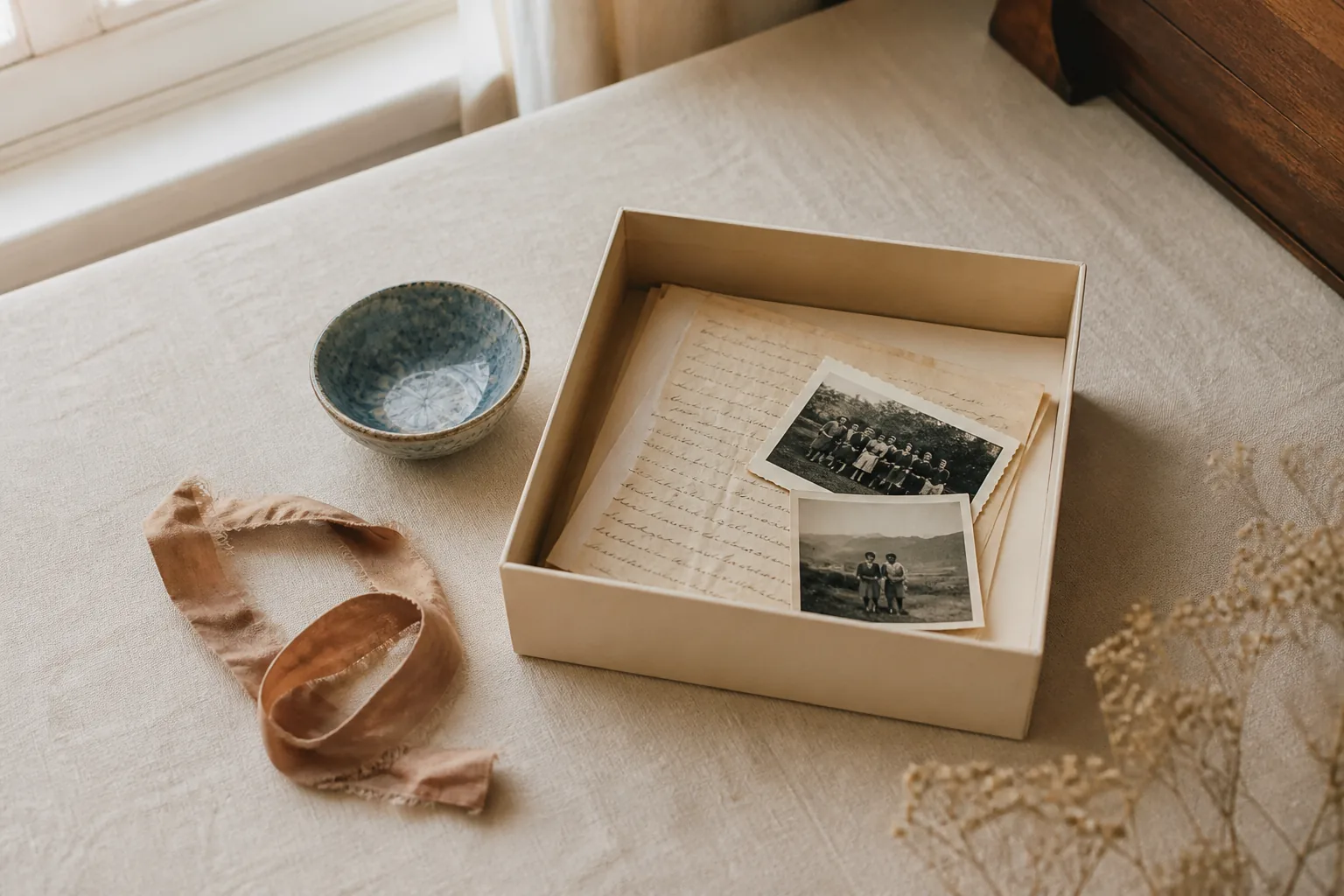
The trouble with a box marked memories is that the label excuses almost anything. A birthday card signed by someone you miss belongs there. So does a hotel key from a trip you barely remember, twelve school programs, a cracked ornament, three baby teeth, and a ribbon whose original occasion has disappeared. Nothing is useless once it has been promoted to evidence.
Sentimental things are not ordinary clutter. They can act as witnesses. They prove that a person existed, that a child was once this small, that a friendship once had a particular language. Asking whether such an object is useful misses its entire job.
But meaning does not organize itself. Without selection, a personal archive becomes a storage problem with excellent emotional credentials. The kinder task is not to become less sentimental. It is to give sentiment enough shape that you can actually encounter it.
A memory and its evidence are different things
Objects can become powerful memory cues. A study of emotional attachment to objects uses the phrase “affect-laden possession-specific bond” and describes possessions as possible repositories for autobiographical memory, extensions of identity, and sources of comfort. That helps explain why a sweater can feel like a person and why discarding a handwritten note can feel alarmingly close to erasing its writer. The bond is not silly. It is doing psychological work.
The object, however, is not the entire memory. It is one route into it.
That distinction creates room for choice. If six objects lead to the same story, you may not need all six to keep the story available. If an object is meaningful only after five minutes of explanation, perhaps the explanation is what needs preserving. If you cannot remember why a ticket stub mattered, keeping the stub does not restore the missing evening.
The question is not whether an item contains a memory. Ask what kind of access it provides. Does seeing it bring someone vividly to mind? Does it carry a detail no photograph could hold? Could another object tell the same story better?
Make the archive earn its shelf
Museums do not display everything they own at once. They select, identify, arrange, and sometimes rotate. A personal collection deserves the same intelligence, even if its museum is one linen-covered box on the top shelf.
Begin with a physical limit that suits your home. It might be one box per person, one drawer for childhood, or one archival case for family papers. The container is not punishment. It is an editorial boundary. It asks every piece to live in relation to the others rather than claiming permanent exemption.
Bring similar items together. The first surprise is often duplication. There are seventeen cards from the same year, five versions of one school photograph, and enough programs to establish beyond dispute that the concert occurred. Choose the example with the strongest handwriting, clearest date, best condition, or most specific story.
Do not start with the hardest object. Begin with repetition. Editing eight nearly identical photographs down to two is emotionally different from deciding the fate of a wedding ring. Early decisions teach you what your archive is for.
Some things need a sentence
A mysterious object becomes more mysterious with every generation. You may know that the small blue bowl belonged to your aunt and sat beside her kitchen sink. To somebody opening the box thirty years from now, it is simply a chipped bowl.
Add a brief note where context matters. Name the person. Give the approximate year. Record the detail the object cannot supply on its own. One useful sentence is often enough.
This was on Grandma June’s desk. She kept peppermints in it and gave us one after school.
That sentence turns a generic container into a family artifact. It also reveals whether the story is genuinely yours. Sometimes we keep inherited things because somebody told us they were important, yet no living person can say why. An unidentified heirloom is allowed to stop being an heirloom.
Photographing can help when the shape matters more than the material. It works especially well for bulky school projects, collections whose significance is visual, and objects already deteriorating. It is less satisfying when texture, handwriting, weight, or use is the point. A photograph of a letter is still the letter’s information. A photograph of your father’s worn work gloves is not the experience of holding them.
Choose the form that keeps what you actually value.
Display changes the relationship
An object hidden for twenty years may be protected, but it is not participating in your life. A meaningful item can sometimes leave the memory box and become part of the room.
Frame one note instead of storing the entire correspondence. Use the serving dish. Put three photographs in a small frame rather than preserving forty in an envelope. Hang the textile where its pattern can be seen. Repair the chair if you truly want the chair.
Display is also a useful test. If you would not use, see, read, or occasionally revisit an item, what role are you asking it to perform? Storage can quietly become a way of postponing the answer.
Not everything precious should be exposed to light or daily wear. The point is not to turn the house into an exhibit. It is to notice whether the collection creates contact or merely consumes custody.
Grief does not follow a sorting schedule
Belongings associated with someone who died need a different pace. A recent study of bereaved adults found that keeping loss-related objects was common. The objects included photographs, clothing, jewelry, and personal belongings, and the way people interacted with them was connected to the experience of grief. That is a good reason to avoid breezy rules about keeping only the best.
If decisions feel physically painful, make preservation the immediate job. Remove food, medicines, leaking batteries, and anything that will damage neighboring items. Gather important papers. Put textiles somewhere dry. Label boxes clearly. You can create safety without demanding finality.
Time alone does not make every decision easy, but it can separate emergency from editing. A box sealed during the first week after a death is not a failed organizing project. It may be the right container for a decision that does not belong to that week.
When you return, sort by relationship rather than resale value. What feels like the person? What tells a story you want to retain? What belongs to another family member? What is merely the residue of a household?
If grief is making daily life unmanageable, organizing advice is not the correct level of help. The box can wait.
Gifts do not require permanent employment
Sentimental collections are often crowded with gratitude. The object was handmade, expensive, chosen carefully, or given by someone important. Releasing it can feel like revising the relationship.
Separate the giver, the event, and the thing. You can remain grateful to the giver. You can remember the event. The thing itself can still be wrong for your home.
Try finishing the sentence plainly. “This mattered because…” If the answer is about the person or moment, decide whether another object already carries that connection. If the answer is only “because it was a gift,” you may be storing evidence of good manners.
A gift has already traveled from one person to another. It completed the gesture. It does not need a lifetime contract.
Build a collection you can revisit
Collections also benefit from hierarchy. Not every retained object needs equal protection or equal visibility. Separate irreplaceable originals from pleasant reminders. A signed letter, sole photograph, or document with family information deserves better materials and a safer location than a mass-produced souvenir. This keeps preservation effort proportional to consequence.
Consider what would happen during an emergency. If the collection contains the only copies of family photographs or records, make a digital backup and tell another person where it is. Do not treat a cloud copy as permission to discard the original automatically. The copy protects information. The original may carry handwriting, scale, texture, and evidence that a scan cannot reproduce.
Finally, remove objects that can harm their neighbors. Newspaper can transfer acid. Adhesive albums can damage photographs. Metal fasteners rust. Damp fabric can affect an entire box. Preservation does not need to become a specialist hobby, but a little separation can prevent one deteriorating item from rewriting the collection for you.
When the choices are made, give the remaining pieces the unglamorous protection they deserve. Remove rubber bands and sticky notes that can stain paper. Keep photographs and documents away from damp basements and hot attics. Use folders or envelopes to prevent small items from becoming one undifferentiated layer. Label the outside with names and a broad date range.
Then make the collection reachable. Not necessarily convenient, but reachable without moving a mattress and six holiday bins. A memory box that can never be opened has become a sealed obligation.
Set no mandatory annual review. Open it when curiosity, family conversation, or a life change gives you a reason. Add selectively. Remove something when its meaning has changed. A personal archive is allowed to remain alive.
The goal is not a tiny box that proves you have conquered attachment. It is a collection whose contents can still speak.
Keep enough evidence to find the stories again. Keep enough context that someone else might find them too. Let the rest return to being paper, fabric, metal, and wood.
Memory deserves better than a pile. It deserves an edit.