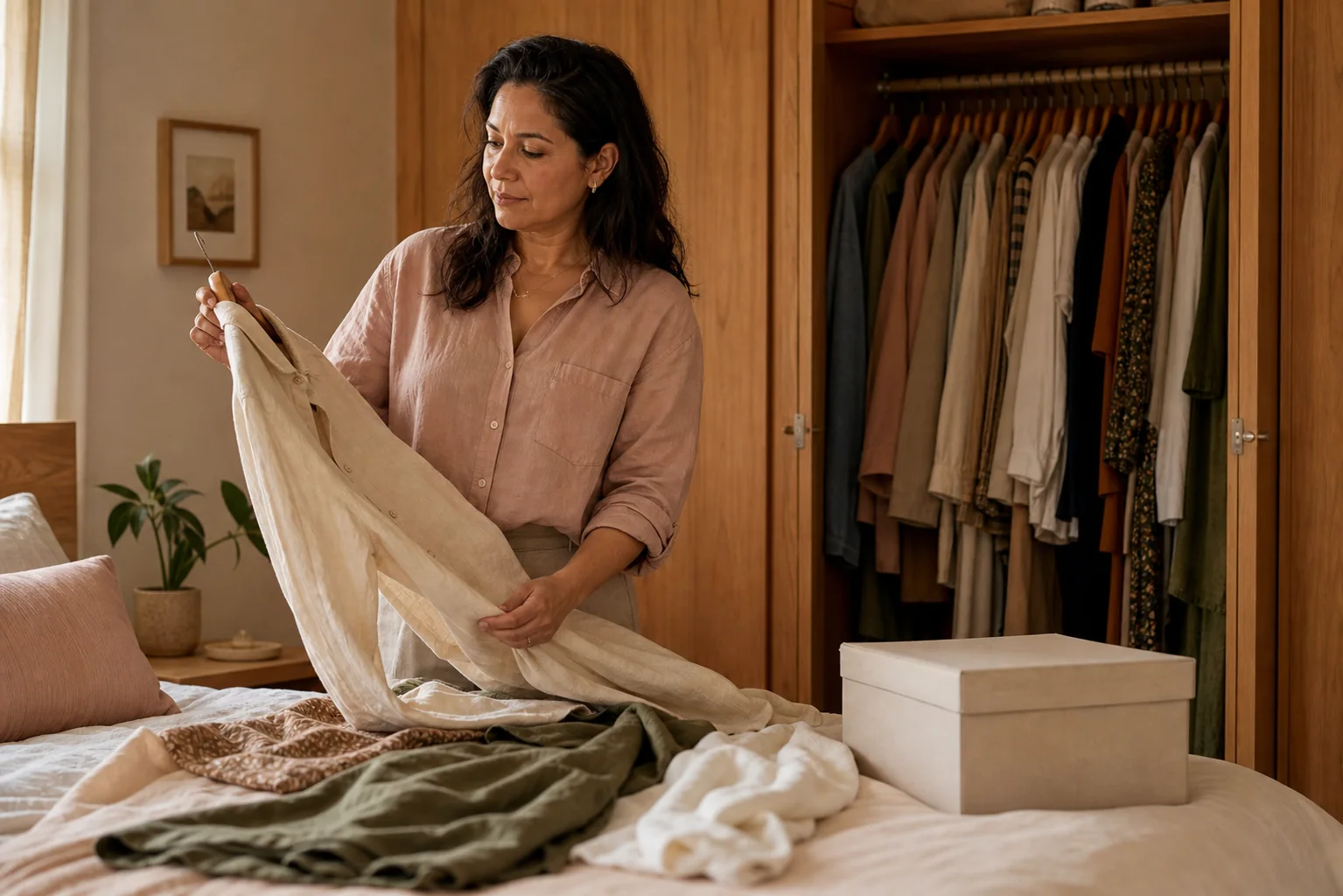
A closet can be full of clothes and still make getting dressed harder than it should be. Thirty shirts. Several pairs of jeans. Jackets for weather that rarely happens. A dress bought for one event. A sweatshirt you would never wear again but would be genuinely upset to lose. Two pairs of pants that might fit again. Three nearly identical black tops, except somehow you keep choosing the same one.
There is plenty to wear. And still, the useful clothes can feel buried beneath every other version of your life. That is what makes decluttering clothes different from clearing out a junk drawer. Clothing is practical, but it is also personal. A closet can hold the job you used to have, the size you used to wear, the person you thought you might become, the expensive mistake you still feel bad about, and the one shirt that technically fits but loses every time you get dressed.
Professional organizer Shaniece Jones put the emotional side of this plainly when she told Good Housekeeping that “the closet is the space that holds our insecurities.” A psychological study of clothing attachment reached the quieter part of the same conclusion. Garments can acquire a symbolic meaning that has very little to do with whether they still belong in Tuesday morning’s outfit. Which is why a useful closet cleanout cannot simply ask whether every item is good enough to keep.
Decluttering clothes is really about deciding which clothes deserve active wardrobe space.
The rest can still have a place. It just may not need to compete with what you are actually trying to wear now.
Your Closet Is Holding More Than Clothes
It is easy to underestimate how many jobs we ask one closet to perform. It stores everyday clothes. Work clothes. Formal clothes. Clothes for weather that may be six months away. Things that almost fit. Things that used to fit. Clothes with memories attached to them. Clothes that were expensive enough to make donating them feel irresponsible. Clothes bought for a life that never quite happened.
That is a lot of emotional and practical traffic for one rod and a few drawers. A better way to sort through it is to separate the wardrobe into two broad roles.
Active wardrobe
Clothes that serve the life you are actually getting dressed for now. They fit your current body, climate, routines and activities well enough to be genuine options.
Archive wardrobe
Clothes you are intentionally keeping for another reason. Sentimental pieces, another realistic size, formalwear, specialized clothing and off-season items can live here without demanding prime daily space.
This is not a minimalist rule. It is a storage hierarchy. The clothes most likely to be worn tomorrow should have an easier life than the clothes you might wear someday.
Start With the Clothes That Are Actually in Rotation
If the whole closet feels overwhelming, do not begin by emptying every drawer onto the bed unless that genuinely helps you think. Start with one category. Jeans. T-shirts. Jackets. Shoes. Work clothes.
Professional organizers often recommend narrowing the scope this way because smaller categories create decisions you can actually finish instead of producing one giant pile that has to be dealt with before bedtime. It is the wardrobe version of making the project smaller than the house. For the clothes in front of you, ask practical questions.
- Does this fit comfortably now?
- Does it work for the life I currently have?
- Would I choose it over similar pieces?
- Do I have a real use for it?
- Does it work with clothes I already wear?
- Would I actually notice if it were gone?
That last question is especially useful. There are clothes we actively dislike, and those are usually easy. The harder category is perfectly acceptable clothing that never wins. The shirt fits. The color is fine. Nothing is wrong with it. Yet when it sits beside three shirts you like more, it loses every time. That is still information. A garment does not have to be bad before it becomes unnecessary in your active wardrobe.
Clothes That Do Not Fit Are Not All the Same Decision
One of the most common decluttering rules is also one of the bluntest. If it does not fit, get rid of it. Sometimes that is exactly right. Sometimes it is unnecessarily rigid. Bodies change. Weight changes. Pregnancy happens. Health changes. Fitness changes. Clothing can be expensive to replace. A high-quality coat that is temporarily the wrong size is a different decision from six mediocre pairs of jeans you have been keeping for years because one day they might become relevant again.
Professional organizer Mindy Godding has recommended separating clothes that do not currently fit from the everyday closet rather than forcing every piece into an immediate keep-or-donate decision. In her advice to Martha Stewart, she suggests labeled storage by size or season when keeping the clothes is deliberate and space allows. If you have a realistic reason to keep another size, choose the pieces deliberately. Keep the excellent coat. Keep the difficult-to-replace trousers. Keep the dress you would genuinely be happy to wear again. You probably do not need an entire secondary wardrobe of clothes you already felt lukewarm about when they fit.
Keep the possibility if you want to. Just stop making the present dress around it.
Give those clothes a boundary. One container. One shelf. One clearly defined section. A boundary turns “maybe someday” from an expanding category into an intentional one.
Sentimental Clothes Can Graduate From the Closet
Some clothes are no longer really clothes. When a garment is carrying a person, period or former self, use the same slower logic as choosing a keepsake that represents the memory well. The college sweatshirt you would never wear outside the house but cannot imagine throwing away may not need to keep proving itself as part of the wardrobe. Neither does the concert shirt from twenty years ago or the jacket that belonged to someone you loved. If you are keeping a garment mainly because of the memory attached to it, acknowledge what it has become.
A keepsake. That changes the decision completely. You no longer have to ask whether it fits perfectly, whether it matches your current style or whether you wore it this year. Those are questions for active clothing. Studies of wearer-clothing relationships support that distinction. A garment can stop functioning as clothing and begin functioning as a memory trigger, which helps explain why some pieces remain important long after their practical role has faded.
The useful question becomes whether this particular piece is meaningful enough to deserve space among your keepsakes. That still requires limits. Sentiment can turn an entire wardrobe untouchable if every memory gets equal storage rights. Pick the pieces that carry the memory most strongly. Store them intentionally. Photographing an item before letting it go can help some people, but it does not have to be the answer for everyone.
A memory does not need a hanger unless you still wear it.
The One-Year Rule Needs an Exception Clause
Another familiar closet-cleanout rule says that if you have not worn something in a year, you should get rid of it. That works beautifully until it does not. WRAP’s study of UK wardrobes found that 26 percent of the average person’s clothing had not been used in the previous year. That number is striking, but the reasons varied. Occasion clothing, outerwear and other specialized pieces can remain unworn simply because the opportunity has not happened.
That matters. A cocktail dress that did not get invited anywhere this year has not necessarily failed. A heavy coat during an unusually warm winter has not failed. A casual shirt you passed over every Saturday for two years is telling you something different. So instead of asking whether you wore the garment within an arbitrary period, ask a better question.
Did this item have reasonable opportunities to be worn, and did I keep choosing something else?
That test respects the difference between rare-use clothing and repeatedly rejected everyday clothing. If an item keeps missing opportunities that were genuinely made for it, the calendar is probably not the problem.
Put the Duplicates Together Before You Decide
Duplicates are another category that gets oversimplified. Five black T-shirts sound excessive until you meet someone who wears black T-shirts almost every day and does laundry once a week. Meanwhile, two nearly identical jackets can be too many if one of them has not left the closet in three years. The problem is not repetition.
The problem is redundancy.
Duplicates sometimes accumulate because people forget what they own or cannot find it easily enough, so buying another feels simpler than locating the original. Professional organizers interviewed by Good Housekeeping describe exactly that kind of duplicate creep.
Clothing adds another layer because true duplicates can also be useful. Put similar pieces together. Pick your favorite. Then your second favorite. Keep going. Eventually you may reach the shirt you would only wear if every better version were dirty. Then the one you would not even choose under those circumstances. That is where duplication starts turning into dead inventory. You do not need a preset number. You need to notice where additional copies stop adding practical value.
Your Closet Has a Capacity Even If the Door Still Closes
Once the obvious categories are handled, a harder question remains.
How much clothing can this particular closet support without becoming annoying to use?
People often ask how many clothes they should own as though there might be one reassuring number. There is not. WRAP has estimated that the average UK adult owns around 118 garments. That is interesting context, not a recommendation. Someone working from home in a mild climate has different needs from someone with a formal office dress code, frequent workouts, four distinct seasons and a busy social calendar. The closet itself gives a better answer.
You have too many clothes when the wardrobe starts making ordinary use harder.
Your wardrobe may be over capacity when
- you regularly forget what you own
- clean laundry has nowhere easy to return
- hangers are packed tightly enough that browsing is annoying
- drawers have to be compressed shut
- clothes routinely migrate onto chairs or other furniture
- you buy replacements for things that were already buried somewhere
- putting clothes away takes noticeably more effort than getting them out
A closet can technically hold more clothing long after it has stopped functioning well. That distinction matters.
The closet does not need to look empty. It needs enough slack to work.
There should be enough room to see choices, move hangers, return clean laundry and maintain whatever system you are using without wrestling with it.
Seasonal Storage Should Not Become Decision Storage
Off-season clothing does not need premium closet space all year if you have somewhere reasonable to store it. Current organizing advice often recommends keeping current-season and frequently worn clothing easiest to reach while moving genuinely seasonal or highly occasional pieces elsewhere. That can make a closet dramatically easier to use. But seasonal storage has one weakness. It can become a very polite way to postpone decisions. Pay attention when the storage bin comes back.
If a sweater comes out for the third winter, hangs around for four months and goes back into storage unworn again, the weather may no longer be the reason. Seasonal rotation is useful because it creates repeated evidence. Eventually an item can run out of excuses.
Before Anything Leaves, Look at What the Pile Is Telling You
This may be the most valuable part of wardrobe decluttering, and it usually happens after the decisions are supposedly finished. Look at the clothes you are letting go. Not garment by garment.
As a group. A 2024 peer-reviewed study of reflective garment decluttering found that the process helped participants understand why they owned particular clothing and recognize patterns in their consumption. Clothing acquisition also fell afterward, although some of that effect weakened over time. The useful part is the reflection. Maybe the outgoing pile contains five versions of the same color you never actually wear. Maybe it is full of sale purchases. Maybe every rejected item is made from a fabric you dislike. Maybe you keep buying clothes for events instead of the ordinary Tuesday that makes up most of your life.
Maybe your closet contains a trail of almost-right jeans because buying another pair has been easier than admitting that a particular cut never works for you.
The donation pile may be the most honest shopping history you own.
Before it leaves, learn from it. If you can identify the pattern that created the clutter, the next closet cleanout may be much smaller.
The Closet Cleanout Is Not Finished Until the Clothes Leave
A bag of donated clothes sitting on the bedroom floor is still wardrobe clutter with better intentions. Finish the exit. Sell pieces when the likely return is worth the listing, messaging and shipping effort. Give things directly when you know someone who genuinely wants them. Donate wearable clothing to organizations that accept it. For damaged textiles, check what local charities, retailers or textile-recycling programs actually take rather than assuming every donation bin can use everything.
The EPA’s clothing guidance makes the local distinction explicit. Gently worn pieces may be suitable for charity donation, while damaged textiles require checking with the charity or a retailer that accepts clothing for recycling. And sometimes an item is simply unusable. You do not need to keep a ruined garment indefinitely because throwing it away feels morally unsatisfying. The decision is not complete until the clothing leaves the room.
A Wardrobe Edit With Room for Exceptions
A useful checklist should help you sort different kinds of decisions instead of pretending every shirt can be judged by the same rule.
Wear Now
- Fits comfortably now
- Works for your current life
- Gets chosen over similar pieces
- Has a clear role in your wardrobe
Archive Intentionally
- Sentimental clothing you are keeping as a keepsake
- Another size you have a realistic reason to retain
- Formal or specialized clothing with an actual purpose
- Genuinely off-season clothing
Question
- Perfectly good clothes you repeatedly pass over
- Duplicates that rarely enter the rotation
- Items waiting for a hypothetical lifestyle
- Clothing you mainly keep because it was expensive
Release
- Clothes that do not fit and have no realistic reason to stay
- Damaged items you are not honestly going to repair
- Redundant duplicates beyond what you use
- Everyday clothes that repeatedly had opportunities to be worn and still lost
Learn
- Notice repeated colors, cuts, fabrics or brands in the outgoing pile
- Notice purchases driven mainly by sales or imagined occasions
- Notice what you keep rebuying
- Use those patterns to make the next purchase harder to regret
You do not need to complete every category in one afternoon.
One drawer that works better afterward is a finished piece of the project.
Tuesday Morning Is the Test
The goal of wardrobe decluttering is not to produce the smallest possible number of hangers. You can own a lot of clothes. You can keep sentimental things. You can save another size. You can own five black shirts if all five actually earn their place. The question is whether the active wardrobe has become easier to understand and use.
Can you see what you own? Can clean laundry go back without negotiation? Do the clothes in front of you mostly belong to the life you are getting dressed for now?
And when you look at the things you removed, did you learn anything about what not to bring back in?
A successful closet cleanout does not leave you with the fewest clothes.
It leaves you with fewer clothes asking you to become somebody else before you can wear them.
The clothes you use now should not have to fight through your entire biography to reach the hanger.