Why do AI tools give out-of-date SEO advice?
A chatbot learns from a huge amount of text written over many years, and SEO has been written about more than almost any web topic. Much of that writing is old, copied from other old writing, or produced by people selling a service. The model has no way to tell a rule Google retired in 2019 from one that still applies, so it repeats the version it saw most often, in a confident tone.
Some tools search the web before they answer, which helps with recent changes and can still pull in a blog post from 2015. The safe habit is to treat any SEO claim from an AI tool as a lead to check, and to check it against Google Search Central, the official documentation, or the tool that would show the effect, such as Search Console.
Which old tags and rules do AI tools still recommend?
These come up again and again in generated code and advice. Each one is either ignored by Google or does the opposite of what the tool claims.
<meta name="keywords">: ignored by Google for well over a decade. Bing may treat a stuffed one as a spam signal.Noindex:inrobots.txt: never part of the standard, and Google stopped honouring it in September 2019.<priority>and<changefreq>in sitemaps: Google says it ignores both. An accurate<lastmod>is the useful optional tag.- A keyword density target such as "use the keyword 2 to 3 per cent of the time": no search engine uses one, and the text it produces reads badly.
- FAQ or HowTo markup to win extra space in results: HowTo rich results were retired in 2023, and FAQ results now appear only for a small set of authoritative government and health sites.
- Exact length limits stated as rules, such as "titles must be under 60 characters": results are cut by pixel width, which varies with the letters and the device, and Google may rewrite any title anyway.
Crawl-delayin robots.txt for Google: Googlebot ignores it.
Why does blocking a page in robots.txt not keep it out of results?
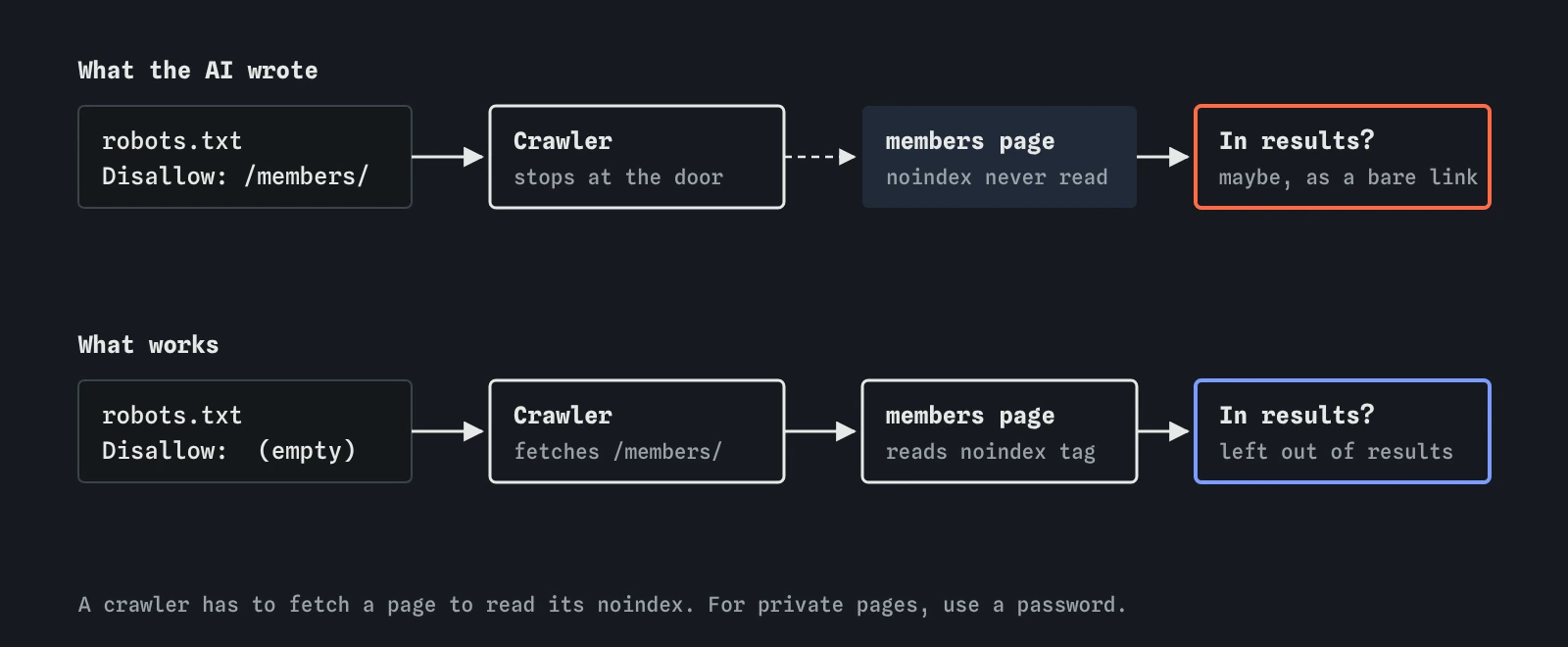
This is the mistake in the demo, and AI tools make it constantly. robots.txt controls crawling: whether a crawler may fetch an address. It says nothing about indexing. If another page links to /members/, Google can still list the bare address in results without ever reading the page, usually with the note "No information is available for this page".
To keep a page out of results you need a noindex rule, either as a robots meta tag in the page's <head> or as an X-Robots-Tag HTTP header. The crawler has to fetch the page to see either one, so the page must not be blocked in robots.txt. Blocking it and adding noindex together is the worst combination: the noindex is never read. For anything private, such as members' details, use a password. Neither robots.txt nor noindex keeps people out.
<!-- members/index.html -->
<head>
  <meta name="robots" content="noindex">
</head>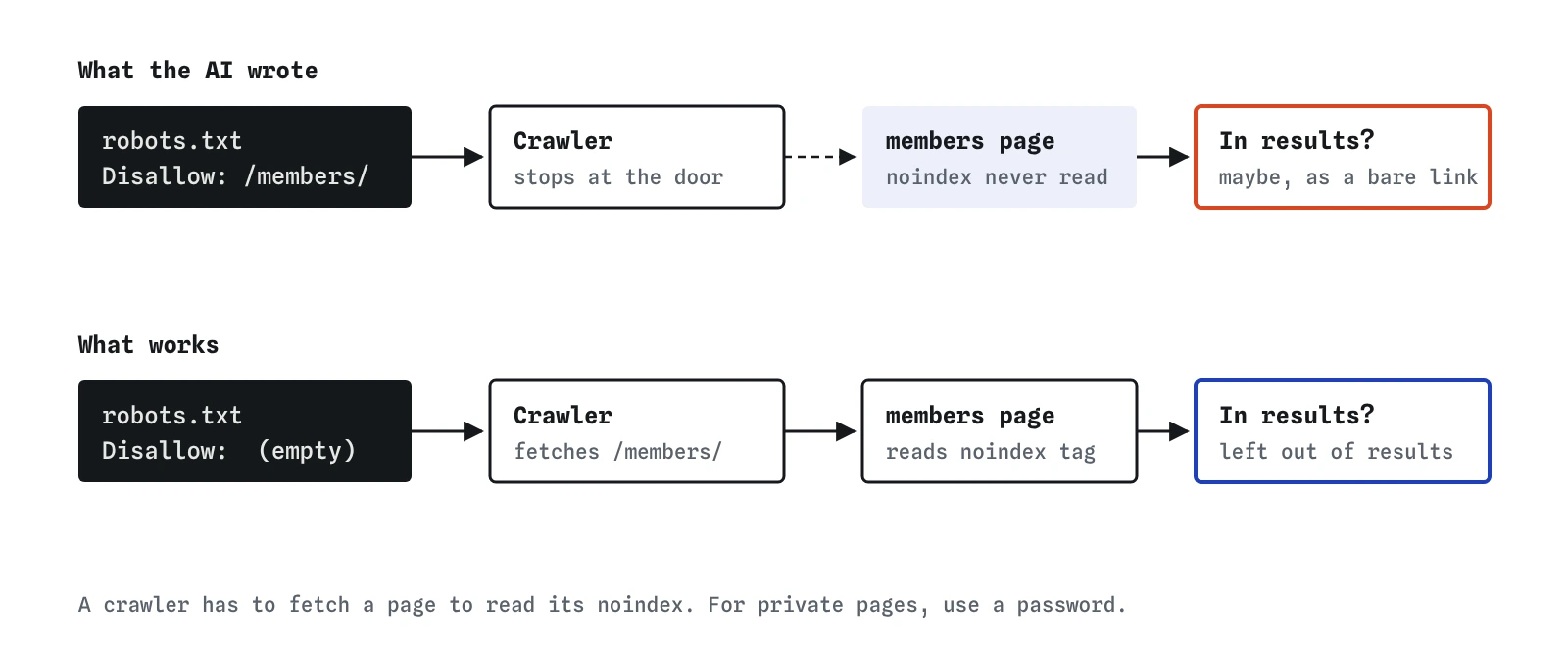
What do AI tools get wrong in canonical tags and share cards?
Generated templates often copy one canonical tag into the shared header of every page, all pointing at the home page. That claims every page is a duplicate of the home page. Google treats canonical tags as a hint and usually ignores ones that make no sense, so at best the tags do nothing; at worst some real pages drop out. Each page should name its own address, or the main copy when it really is a duplicate.
Open Graph tags have their own favourite error: a relative image path such as /img/heron.jpg. Messaging and social apps fetch the image from their own servers, so they need the full https:// address. The same tools often write name="og:title" instead of property="og:title", which some apps accept and others skip.
Can AI tools promise rankings or traffic?
No one can, AI or human. Rankings depend on what each person searched, where they are, which device they use, what other pages exist and many signals only the search engine sees. When an AI answer says a change will "boost your ranking", get you "on page one in 30 days" or "guarantee more traffic", it is repeating marketing copy. Google's own guidance on hiring an SEO warns against anyone who guarantees rankings.
A more honest framing is that a change makes a page eligible for something, removes an obstacle, or helps a person decide whether the result is what they want. Whether that leads to more visits shows up later in Search Console's Performance report, and is never certain.
Is it fine to publish pages written by AI?
Google's position is that it rewards helpful content however it was produced, and that using automation mainly to manipulate search rankings breaks its spam policies. Since March 2024 the scaled content abuse policy has named the pattern directly: many pages generated to rank, with little original value. A site of fifty "Bird walks in [town]" pages with the town swapped in is the obvious example, and it can lead to the whole site being demoted.
Using a tool to help draft a page you then check, correct and add your own knowledge to is ordinary writing. The test is the same as for any page: does it say something true and useful that a visitor could not get from the ten pages already out there? For the bird club, real sightings, real walk times and a real leader's notes are things no tool can make up honestly. Check every fact an AI tool writes for you, because invented opening times or prices hurt visitors first.
Do you need special files or tricks for AI search features?
Google says pages need nothing extra to appear in its AI features, such as AI Overviews and AI Mode. The same requirements apply as for ordinary results: the page must be indexed and eligible to show a snippet, and the usual guidance on helpful content applies. Advice to add special markup "for AI" or to write in a particular question-and-answer pattern goes beyond anything Google documents.
You will also see suggestions to add an llms.txt file. It is a proposal some sites use, and Google has said its search systems do not read it. The Google-Extended token in robots.txt controls whether your content is used to train and ground Google's Gemini models; it does not change crawling or ranking in Google Search.
How do you check an AI tool's SEO advice?
Ask it for a source, then open the source. If the answer cites Google Search Central, find the page and read the current version, which shows a last-updated date. If there is no source, look it up yourself. Then test the change where the lab or a real tool can show the effect: the Checks view here, the URL Inspection tool and Pages report in Search Console, or the Rich Results Test for structured data.
Watch for a few warning signs: any promise of positions, any exact percentage or character count stated as a rule, any tag you have never seen in official documentation, and any advice to block, hide or cloak something from crawlers. The lab simplifies plenty, as the Index view notes say, but the rules it checks here follow Google's published behaviour closely.
Field notes
- AI tools often repeat old advice, such as the meta keywords tag, which Google ignores.
- Blocking a page in robots.txt does not keep it out of results, whatever an AI tool says.
- Nobody can promise a ranking or a traffic figure, so treat such promises as a warning sign.
- Check advice against Google Search Central documentation and test it in the lab or Search Console.
Easy to get wrong
Noindex: in robots.txt is not supported, and Disallow stops the crawler reading any noindex on the page. Let the page be crawled and put the noindex in its head.
Apps fetch share images from their own servers and cannot resolve a relative path. Use the full address.
Mass-produced pages with little original value fall under Google's scaled content abuse policy, and visitors find them useless.
Google ignores priority and changefreq. An accurate lastmod, changed only when the content changes, is the optional tag it uses.
Questions people ask
Should I stop using AI tools for SEO?
No. They are quick at drafting titles, spotting broken links in pasted code and explaining terms. Treat their claims about how search works as unverified, and check them against official documentation or a test.
Does Google penalise content written with AI?
Not for being written with AI. Its spam policies target content made mainly to manipulate rankings, especially at scale, whoever or whatever wrote it. Helpful, accurate pages are fine.
Where can I check whether an SEO rule is still current?
Google Search Central documentation, which shows when each page was last updated, and the Google Search Central blog for announced changes. Bing Webmaster Guidelines cover Bing.
An AI tool says my site needs schema on every page. Is that right?
Only where it describes something on the page, such as an event, a business or a product, and only for types that can produce a result. Markup for content that is not on the page breaks Google's guidelines.