What do people type into a search box?
Most searches are short and plain. Someone near the bakery types "bakery near me", "sourdough mill lane" or "crumb and crust opening times". Someone planning a party types "birthday cake order 2 days". People rarely use full sentences. They misspell names, and they use the words they would say out loud to a friend.
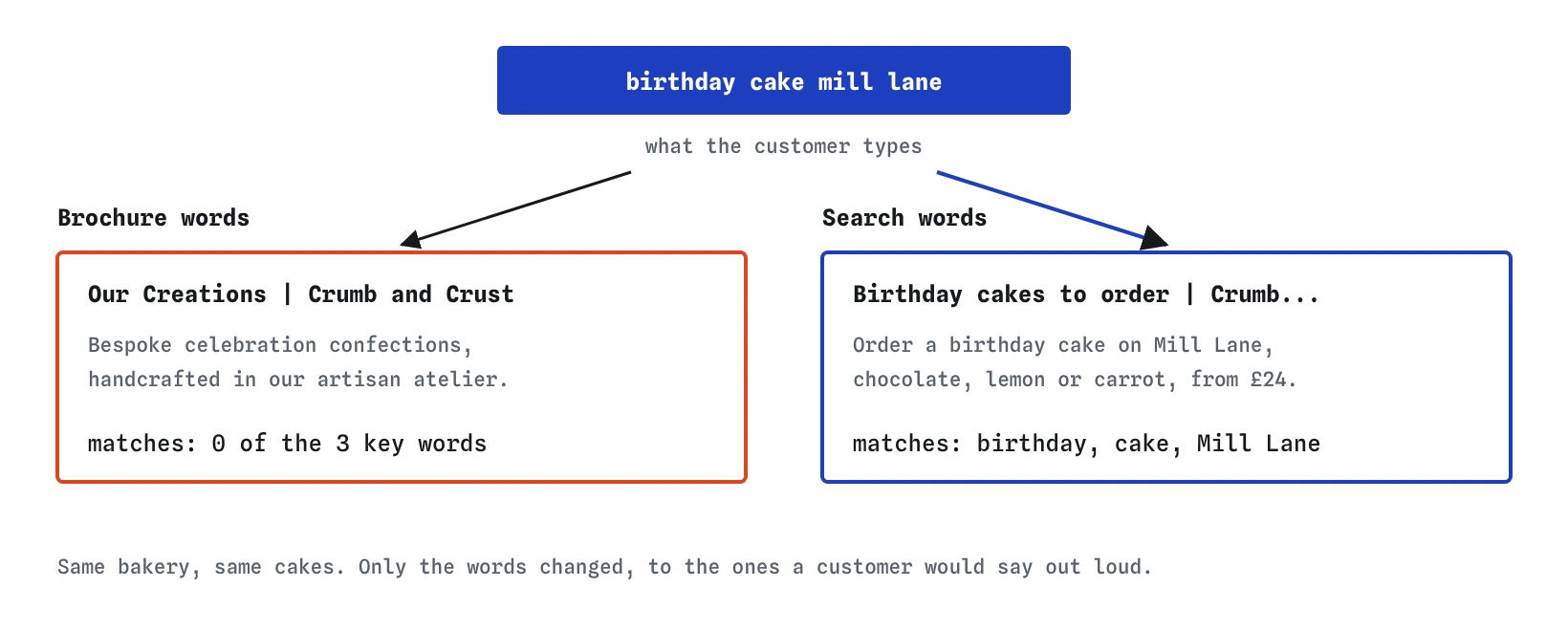
The words a person types are called a query. The words a business uses to describe itself are often quite different. A baker might say "celebration cakes"; a customer says "birthday cake". A bird club might say "field excursions"; a beginner says "bird walk". Search engines are good at matching related words, and Google has used language models to understand meaning for years. The closer your page is to the searcher's own words, the easier it is for both the engine and the person to see it fits.
Longer, conversational searches have become more common as people get used to asking questions and using voice search and AI answers. They still come down to the same thing: a need, often with a place or a time attached.
What is search intent?
Intent is what the person wants to happen after they search. The same words can carry different intents, and the results reflect the most likely one. People usually group intents into a few kinds.
- Find a specific place or site: "crumb and crust", "spoke and chain canal street". The person already knows who they want.
- Learn something: "how long does sourdough keep", "what birds sing at dawn". They want an answer.
- Do or buy something: "order birthday cake mill lane", "hire tandem". They are ready to act.
- Compare: "best bike shop for repairs near me". They are choosing.
How does intent shape a page?
Each page works best when it answers one main intent. The Crumb and Crust cakes page answers "I want to order a birthday cake". That tells you what the page needs: sizes, flavours, price, notice and how to order. A long history of the bakery belongs on the About page instead.
Look at what already appears when you search for the words you have in mind. If the first results for "sourdough" are recipes and explanations, a bakery's product page is answering a different intent, and the bakery should expect its customers to add a place, as in "sourdough mill lane". This is one of the most useful habits in SEO, and it costs nothing.
How can you find the words people use?
You do not need paid tools for a small site. Start by listening. Write down the words customers use on the phone, in emails and at the counter. Those words are the queries.
Then use what search engines show you. Start typing in the search box and read the autocomplete suggestions, which come from real searches. Scroll down a results page to the "People also ask" box and related searches, when Google shows them. Google Trends compares how often terms are searched over time and by region, which helps with choices like "cycle hire" against "bike hire".
Once your site is in Search Console, the Performance report is the best source of all. It lists the actual queries your pages appeared for, with impressions, clicks, click-through rate and average position. Words that bring impressions and few clicks often point at a title or description that does not match what people wanted. Keyword tools from SEO companies estimate search volumes. Treat their numbers as rough guides.
Where do the searcher's words belong on the page?
Put the main words in the places that describe the page: the <title>, the <h1>, the meta description and the opening paragraph. Use them naturally, the way you would in a sign on the shop window. The rest of the text should answer the questions that come with the intent, in the words people would use.
There is no number to hit. No search engine has ever published a target "keyword density", and repeating a phrase makes text worse for the person reading it. Google's spam policies name keyword stuffing directly. Say the thing once in each place it belongs, then get on with being useful.
<title>Birthday cakes to order | Crumb and Crust</title>
<meta name="description" content="Order a birthday cake from Crumb and Crust on Mill Lane, in chocolate, lemon or carrot, from £24.">
<h1>Birthday cakes</h1>
What about searches with a place in them?
Many searches for small businesses include a place, or imply one. "Bakery near me" carries the searcher's location even without a street name. Google uses that location to choose local results, which draw mostly on Google Business Profile listings. Google says it orders them by relevance, distance and prominence, and reviews are part of prominence. Your own pages help by stating the address, the area and the opening hours in plain text.
Writing the street name into a title is fine when it is true and helpful, such as "bike shop on Canal Street". Creating a separate page for every nearby town with the same text and the town name swapped is a doorway page, which Google's spam policies forbid. The local search lesson covers this in more detail.
What does the lab show, and what can it not show?
The lab shows how your words appear in a result sketch, and whether the title and description come from your files or get replaced. It cannot tell you what anyone searches, how often, or where your page would land, because there are no searchers in the lab. The task checks here look for the plain words a real customer would use, as a stand-in for the research you would do on a real site.
What do AI tools get wrong about search words?
AI assistants often suggest a list of "high-volume keywords" with made-up search numbers, then tell you to use each one a set number of times. The numbers are usually invented, and the repetition makes the page read badly. Check any figure against Search Console or Google Trends, and write for the person.
They also tend to produce brochure language, with words like "bespoke", "curated" and "artisan", which is exactly the gap between brochure words and search words. Read the suggested text and ask whether a customer would ever type those words.
Field notes
- Search intent is what the person wants to do: learn something, find a site, compare options or buy.
- A page fits a search when its content matches the intent, which matters more than repeating the exact words.
- Search Console queries, the search box suggestions and your own customers show the words people use.
- Put the words people use in the title, the main heading and the opening text, written naturally.
Easy to get wrong
The title link is the first thing a searcher reads. Use the words they typed, so they can see the page fits.
Repeating a phrase is keyword stuffing, which Google's spam policies name. One natural mention in each place that describes the page is enough.
A high number means nothing if the people searching want something your page does not offer.
Questions people ask
Do I need a paid keyword tool?
Not for a small site. Customer conversations, autocomplete, related searches, Google Trends and the Performance report in Search Console cover most of what you need.
Should I target one keyword per page?
Aim each page at one main intent. A page will appear for many related queries anyway, and Search Console shows you which.
Does spelling matter?
Search engines correct common misspellings, so you do not need to write the wrong spelling on your page. Use the correct spelling of your products and place names.
How do I know which queries my site already appears for?
Open the Performance report in Search Console and look at the Queries tab. It shows real queries, impressions and clicks for your verified site, with a delay of a couple of days.