What is a sitemap?
A sitemap is a file that lists the addresses on your site that you want search engines to crawl. The usual kind is an XML file at an address like https://riversidebirds.example/sitemap.xml. Each entry gives one full address and, optionally, the date the page last changed in a meaningful way.
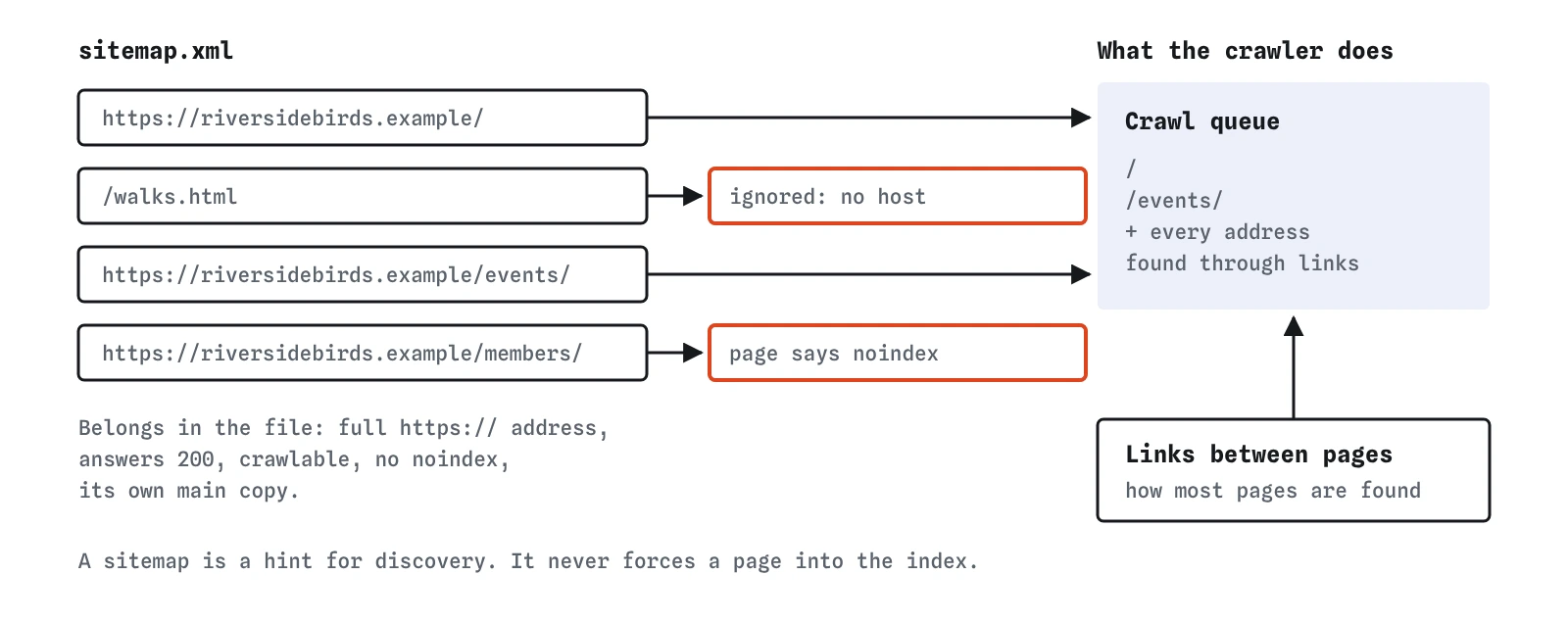
It is a hint. Crawlers still find most pages by following links, and a sitemap does not force a page into the index or change where it appears. What it does is make discovery more reliable: a new page, a page buried deep in the site, or a page that only a few others link to gets on the crawler's list sooner.
Small sites with good links between pages often get on fine without one. Google says as much. Still, a sitemap takes minutes to make, most site builders and content systems create one for you, and it gives Search Console a list to compare against, so you can see which of the pages you care about made it into the index.
What goes in the file?
The file starts with an XML declaration and a <urlset> element that names the sitemap vocabulary. Inside, each page gets a <url> block with a <loc> for its address. You can add <lastmod> with a date in the W3C format, such as 2026-10-27, or a date and time with a time zone.
Every <loc> must be a full, absolute address with the protocol and host, exactly as you want it shown in results. Write https://riversidebirds.example/events/, never /events/. Use the version of each address you treat as the main copy: if your pages use HTTPS without www, every entry should too, with the same trailing slashes your links use.
A single sitemap can hold up to 50,000 addresses and must be no larger than 50 MB uncompressed. A large site splits its addresses across several files and lists them in a sitemap index file. A bird club will never come near that limit.
<?xml version="1.0" encoding="UTF-8"?>
<urlset xmlns="http://www.sitemaps.org/schemas/sitemap/0.9">
  <url>
    <loc>https://riversidebirds.example/events/</loc>
    <lastmod>2026-10-27</lastmod>
  </url>
</urlset>
Which pages belong in a sitemap?
List the pages you want to appear in search, and only those. Each one should answer with a 200 status, be crawlable under robots.txt, carry no noindex, and be its own main copy rather than an alternate that points elsewhere with a canonical tag.
Leave out pages that redirect, pages that are gone, duplicates such as /walks.html?sort=date, and pages tagged noindex like the club's members' area. Listing those sends mixed signals: the sitemap says "index this" while the page says the opposite. Search engines cope, but Search Console then fills with warnings that hide the problems you need to see.
A useful way to think about it: the sitemap is your answer to the question "which pages on this site should someone be able to find in search?" If a page is not on that list, it should not be in the file.

Does lastmod help, and what about priority and changefreq?
Google reads <lastmod> and uses it to decide when to recrawl a page, but only if the dates on your site turn out to be consistently accurate. If every entry says today, or some dates are in the future, the search engine learns that your dates mean nothing and stops trusting them. Change <lastmod> when the content of the page changes in a way a reader would notice, such as a new event or a new price, and leave it alone when you only fix a typo or update the footer year.
Google ignores <priority> and <changefreq> completely. Bing has said it ignores them too. Plenty of generators still add them, and plenty of AI answers still recommend setting the home page to 1.0 and blog posts to 0.8. The tags do no harm, but they do nothing, so leaving them out keeps the file honest and short.
How do search engines find your sitemap?
There are two good ways. The first is a Sitemap: line in robots.txt with the full address of the file. Every crawler that reads robots.txt sees it, and you can list more than one sitemap this way.
The second is to submit the sitemap in Google Search Console, in the Sitemaps report, and in Bing Webmaster Tools. Submitting once is enough. Search engines fetch the file again on their own schedule, so there is no need to resubmit after every change. Google retired its old sitemap "ping" address in 2023, so any tool or plugin still pinging it is wasting a request. Bing and some other engines also accept IndexNow, a separate way for a site to announce changed addresses straight away.
Search Console's Sitemaps report shows when Google last read the file, how many addresses it found, and any errors. The Pages report can be filtered to the addresses in one sitemap, which is the quickest way to see which listed pages are indexed and why the rest are not.
robots.txt: addSitemap: https://riversidebirds.example/sitemap.xmlon its own line.- Search Console: Indexing, then Sitemaps, then enter
sitemap.xmland submit. - Bing Webmaster Tools: Sitemaps, then submit the same full address.
What do AI tools get wrong about sitemaps?
They recommend <priority> and <changefreq> values as if they changed something. They tell you to set every <lastmod> to today so the site looks fresh, which teaches search engines to ignore your dates. They suggest resubmitting the sitemap every week, or pinging search engines after each change, when one submission and an accurate file are enough.
They also blur what a sitemap can do. A sitemap does not get a page indexed on its own, and it does not move a page up the results. If a listed page is thin, duplicated or blocked, it stays out whatever the sitemap says. And AI tools sometimes generate sitemaps with relative addresses, a staging host or http:// entries for an HTTPS site, all of which search engines ignore or treat as a different page.
Should every page still have a link?
Yes. A sitemap helps crawlers, and links help crawlers and people. The events page in the task was found only because the sitemap listed it. A visitor on the home page had no way to get there, and internal links also tell the search engine which pages you think are important and what they are about.
Treat the sitemap as a safety net under good linking. When you add a page, link to it from at least one page people already visit, and let your site builder add it to the sitemap. When you remove a page, take it out of the sitemap and either redirect its address or let it answer 404.
Where does the lab simplify?
The lab always reads /sitemap.xml, as if you had already submitted it in Search Console. A real crawler only uses a sitemap it was told about, through a submission or a Sitemap: line. The lab also reads one plain sitemap file. It does not model sitemap index files, image or video sitemaps, or compressed .xml.gz files.
The lab reads the sitemap once and crawls everything at once. Real search engines may take days to fetch a new sitemap and longer to crawl what it lists, and Search Console's numbers lag behind both.
Field notes
- A sitemap lists the canonical addresses you want crawled, in a file usually named sitemap.xml.
- Only include pages that answer 200, are indexable and are the main copy.
- Google uses lastmod when it is accurate, and ignores priority and changefreq.
- Tell search engines about the sitemap in robots.txt and submit it in Search Console.
Easy to get wrong
Sitemap entries must be full addresses with the protocol and host. A relative path is ignored.
A date in the future is not believable, and Google ignores <priority>. Use the real date the content last changed and leave the other tag out.
The sitemap should agree with the pages themselves. Mixed signals fill Search Console with warnings and waste crawls.
The Sitemap: line in robots.txt needs the full address of the file.
Questions people ask
Does my site builder make a sitemap for me?
Most do. Common content systems and site builders publish one automatically, often at /sitemap.xml or /sitemap_index.xml. Open it in a browser to check it lists the pages you expect and uses your real domain.
Will submitting a sitemap get my pages indexed faster?
It can help crawlers discover new pages sooner. It does not guarantee indexing, and it does not change where a page appears. Pages still need to be useful, crawlable and free of noindex.
Do I need to resubmit my sitemap when I add a page?
No. Search engines refetch a sitemap they know about on their own schedule. Keep the file accurate, and use URL Inspection in Search Console if one new page is urgent.
Can a sitemap list pages on another domain?
Only in special setups where you prove you own both sites. For a normal site, list addresses on the same host and protocol as the live pages. Entries for any other host are ignored.