How is a local search different?
Some searches only make sense with a place attached. Someone typing "bakery near me", "bike repair Riverside" or "cake shop open Sunday" wants a business they can walk to, ring or visit today. For those searches, Google and Bing usually show a map with a short list of businesses above or among the normal results. Google calls that block the local pack, and each entry links to a business profile with the address, hours, phone number, photos and reviews.
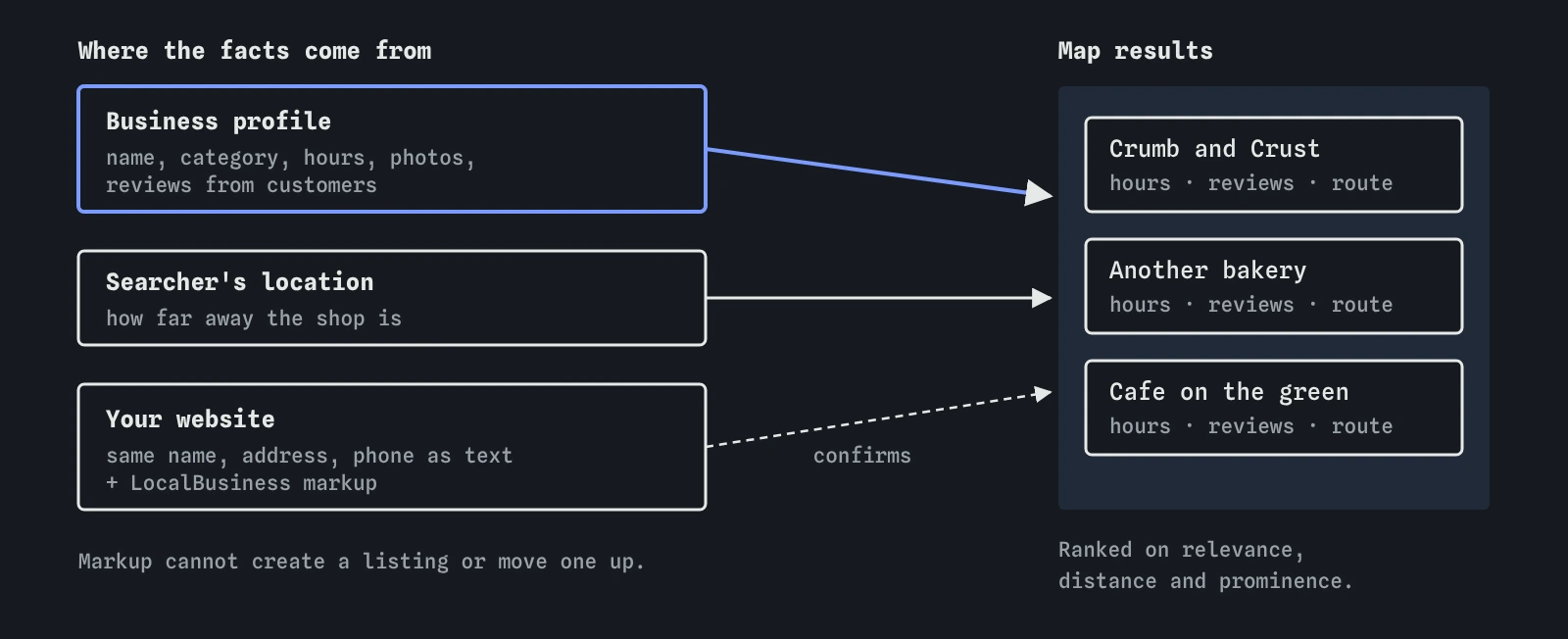
The facts in that block come mostly from a business profile the owner manages with the search engine, rather than from the business's website. Your site still has a part to play, but the biggest single step for a shop like Crumb and Crust happens outside the HTML files in this lab.
Where do those map results come from?
On Google, the source is Google Business Profile, a free listing the owner claims and verifies. On Bing, it is Bing Places for Business, which can import an existing Google profile. Apple Maps uses Apple Business Connect. Each one asks for the business name, category, address or service area, phone number, website, opening hours and photos, and each one asks you to confirm you run the business, often with a video of the premises, a phone call or a postcard to the address, depending on the case.
Google says it ranks local results mainly on three things: relevance (how well the profile matches the search), distance (how far the business is from the searcher or the place named in the search) and prominence (how well known the business is, which includes reviews and what the web says about it). You can improve relevance by filling the profile in completely and choosing the right category. You cannot change distance, and prominence grows slowly with real customers. Nobody can promise a place in the map results, and anyone who does is selling something.

What can your own website add?
Your site is where the profile's website link goes, and it is one of the places search engines check the business details against. A page that states the name, full address, phone number and opening hours in plain text, in the same form as the profile, helps confirm those details. People often call this keeping your NAP consistent, short for name, address and phone. If the profile says 14 Mill Lane and the site says Unit 2, Old Mill Lane, both people and programs have to guess which is right.
The site also answers the questions the profile cannot: what is on the menu today, how much a birthday cake costs, how far ahead to order. Those pages can appear in normal results for searches such as "lemon cake to order Riverside", which is often where a small business wins most of its visits.
- One page with the full address, phone and hours, linked from every page.
- The same name, address and phone wherever the business appears, down to the spelling.
- Text a person can read and copy. An address only inside a map image cannot be read by crawlers.
- Hours that are kept up to date, including holidays, on the site and the profile together.
What does LocalBusiness markup do?
Structured data lets you state those same facts in a fixed vocabulary from schema.org. LocalBusiness is the general type, and there are more specific ones such as Bakery, BicycleStore and Restaurant. Google's documentation lists name and address as required, and recommends telephone, url, geo and openingHoursSpecification.
The markup helps search engines read your details reliably. It does not create a map listing, it is not a substitute for a business profile, and it does not move a business up the local pack. Google's own help on local results points businesses to their profile, not to markup. Treat the markup as a tidy second copy of facts that are already visible on the page.
{
  "@context": "https://schema.org",
  "@type": "Bakery",
  "name": "Crumb and Crust",
  "telephone": "+44 1632 960418",
  "address": {
    "@type": "PostalAddress",
    "streetAddress": "14 Mill Lane",
    "addressLocality": "Riverside",
    "postalCode": "RV2 4LB"
  },
  "openingHoursSpecification": [
    {"@type": "OpeningHoursSpecification", "dayOfWeek": "Sunday", "opens": "08:00", "closes": "13:00"}
  ]
}
How should opening hours be written?
In openingHoursSpecification, each object covers one or more days with the same hours. dayOfWeek takes day names such as Tuesday, and opens and closes take 24 hour times such as 07:00 and 16:00. Leave a closed day out of the list. For a holiday, add an object with validFrom and validThrough dates and the special hours.
The hours that matter most to customers are the ones in the business profile, because that is what the map shows. Google Business Profile has a separate section for special hours, where you can set shorter hours for a day such as Christmas Eve or mark a day as closed. If you change your hours, change them in the profile, on the page and in the markup on the same day.
Should a business mark up its own reviews?
No. Since 2019 Google has not shown review stars for LocalBusiness or Organization pages when the reviews are about the business itself and are published on its own site. These are called self-serving reviews. You can still show kind words from customers on the page for people to read; adding aggregateRating markup to them will not produce stars, and fake or copied ratings break Google's spam policies.
Reviews that count for local results are the ones customers leave on the business profile. Ask happy customers to leave one, reply politely to all of them, and never pay for reviews or offer a discount in exchange. Google Business Profile forbids incentivised reviews and removes them when it finds them.
What about a business with no shop front?
Some businesses visit their customers, such as a mobile bike mechanic or a cake maker who delivers. Google Business Profile lets them set a service area, a list of towns or postcodes, and hide the street address. On the website, describe the area in plain words, such as "we come to you anywhere in Riverside and the villages within ten miles", and keep the contact details the same as on the profile.
Avoid making a near copy of the same page for every town nearby, each with the town name swapped in. Google treats pages made to catch searches for many places, with little unique content, as doorway pages, which its spam policies cover. One clear service area page is more honest and easier to keep accurate.
What do AI tools get wrong about local search?
AI tools often say that adding LocalBusiness markup will get a business into the map results. The map results come mostly from the business profile, and the markup is a supporting signal at most. Ask the tool where its claim is documented, and check Google's own pages on how local results are ranked.
They also suggest stuffing keywords into the business name, such as "Crumb and Crust Best Bakery Riverside Cakes". Google Business Profile guidelines require the real name the business uses on its signs and paperwork, and profiles with stuffed names can be suspended. Other common errors are generated aggregateRating markup with invented numbers, a list of town pages with swapped place names, and opening hours copied into markup that no longer match the page. The lab simplifies all of this: it can check that your markup is valid and matches the page, but it has no business profile, no map and no reviews, which are the parts that decide local results.
Field notes
- Local results and the map mostly come from Google Business Profile listings.
- Your site supports the listing with a consistent name, address, phone number and hours.
- LocalBusiness markup describes the business, and the details must match what the page shows.
- Google does not show review stars from a business marking up reviews of itself.
Easy to get wrong
The name in markup and in the business profile should be the name on the shop sign. Stuffed names break profile guidelines and the markup no longer matches the page.
Crawlers read text. People also want to copy an address into their own map app, which an image does not allow.
Google does not show stars for self-serving reviews of a local business, and invented ratings break its spam policies.
Questions people ask
Do I need a website to appear in local results?
No. A business profile alone can appear in the map results. A website helps people decide, answers questions the profile cannot, and can appear in normal results for more specific searches.
Does it cost anything to have a business profile?
Google Business Profile, Bing Places and Apple Business Connect are free. Ads in local results are a separate, paid product and are labelled as sponsored.
Why does a competitor further away appear above me?
Distance is one factor out of several. Relevance and prominence also count, and the results change with where the person is standing and the exact words they typed. Fill in your profile fully and keep it current; the order is not something you can set.
Should I use `LocalBusiness` or a more specific type?
Use the most specific type that fits, such as Bakery or BicycleStore. Every specific type is also a LocalBusiness, so nothing is lost.